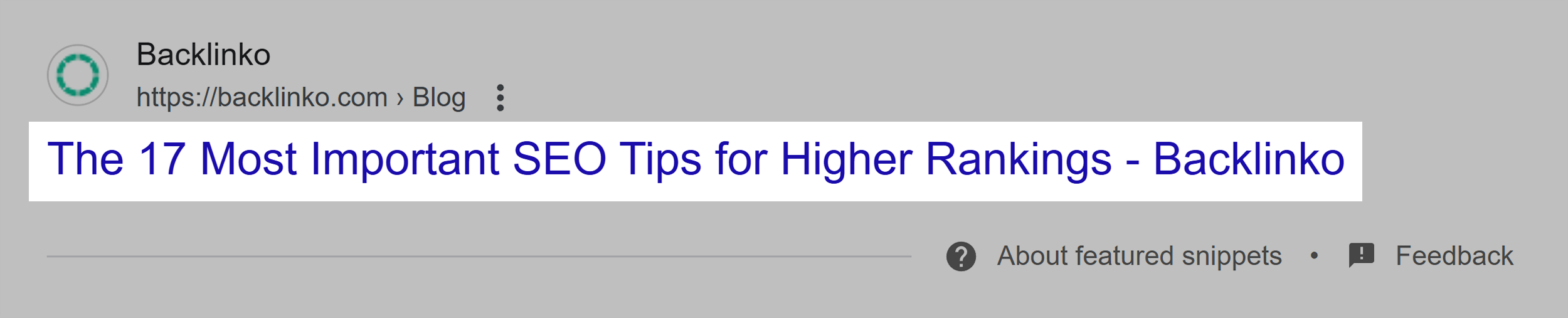
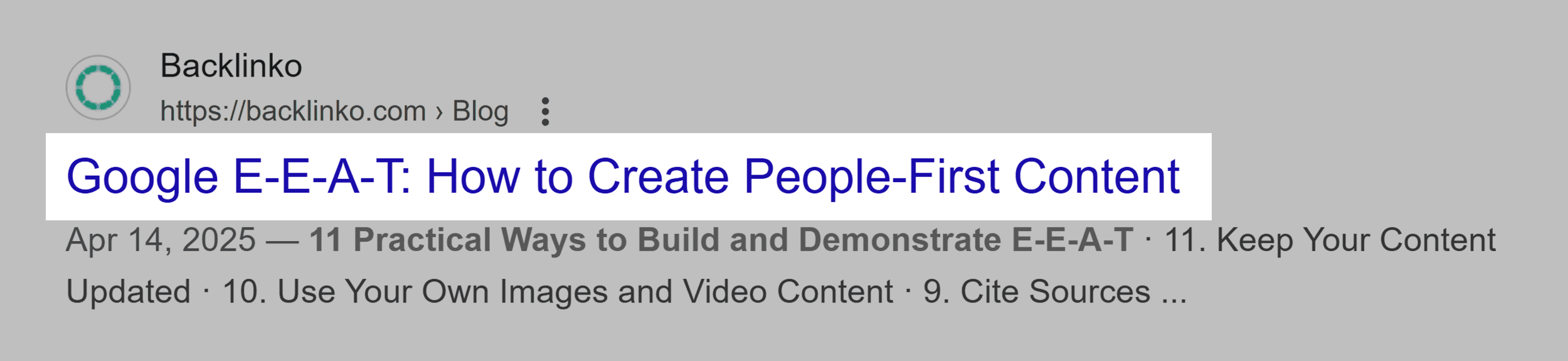
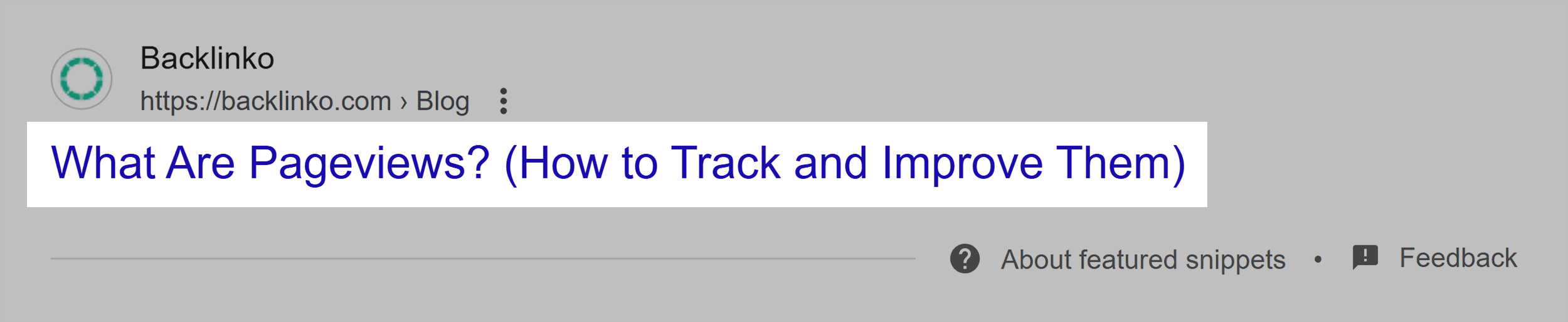
Title tags are the blue, clickable headlines that show up in search results. They’re how you convince a reader to choose your content over someone else’s.
And they matter more than ever.
A Pew Research Center study found that users are roughly half as likely to click a traditional search result when an AI Overview appears.
The good news: A strong title tag can help you win some of those clicks back, whether you’re competing against an AI Overview or cited as a source within one.
In this guide, you’ll learn what makes a title tag work, a simple framework for writing them, and how to analyze and improve the ones you already have.
Plus, I’ve included AI prompts to make writing great title tags faster and easier.
Free resources + AI prompt
Ready to start improving your title tags right away? Download our:
“Help me write a title tag for [YOUR KEYWORD] using the Backlinko formulas and checklist I’ve attached.”
What Is a Title Tag?
A title tag is a line of HTML code that tells search engines (and searchers) the title of your webpage.
Think of it as your content’s elevator pitch — your chance to convince a searcher that you have the answer to their questions.
It doesn’t appear on the page itself.
Instead, it shows up as a blue hyperlink in search engine results:
As the text on a browser tab:
And in some social media previews of your web content:
Behind the scenes, it looks like this in your website code:
<title>How to Create an Effective SEO Strategy in 2025</title>
Why Title Tags Matter
If you nail your title tags, you’ll also:
Improve the user experience: A title that accurately reflects your page content sets the right expectations before anyone clicks, which should encourage lower bounce rates
Boost click-through rates:Google’s guide says title tags are often the primary piece of information people use to decide which result to click
Help search engines understand your content: Google processes your title tag during indexing to understand what your page is about
Stand out in AI search: LLMs and Google (AI Overviews and AI Mode) display title tags alongside cited sources. Once your page is included, a compelling title is what convinces someone to click your result over competing options, helping you drive traffic from AI search.
There’s one more reason title tags in SEO are so important: If you get them wrong, Google might just rewrite them.
And when that happens, you lose control over what shows up in the SERP.
Sometimes Google will just grab the heading (H1) of the page. Other times, it’ll generate something entirely new. And not always better.
If you want to help ensure your pages look polished in the search results, writing a solid SEO title tag that adheres to best practices is non-negotiable.
Title Tags vs. H1 Tags
Personally, I used to muddle these up. So if you’re confused about the difference between title tags and H1s, you’re not alone.
Element
Title Tag
H1 Tag
Where it appears
In SERPs and the browser tab
At the top of the webpage where people can read it (e.g., the title of a blog post)
What it looks like (HTML code)
<title>Your Page Title</title>
<h1>Your Page Heading</h1>
Who is it for?
Mainly for search engines and clicks
Mainly for readers
What does it do for SEO?
Improves rankings and CTR
Supports on-page structure and confirms your page is relevant to the search query
Your title tags and H1 tags should both convey the same information.
They don’t need to be word-for-word the same, though.
This title tag would likely get rewritten because it’s stuffed with keywords.
It’s also just annoying for readers.
Better:“Email Marketing Guide for Beginners (2026 Edition)”
Front-loaded keyword, used once, in a natural way.
Want to try it out yourself?
Here’s an AI prompt you can use to incorporate these rules when writing your title tag:
You are a digital marketing specialist focusing on SEO and content strategy.
Your task is to craft a title tag that is clear, clickable, and offers context to enhance search engine ranking and user engagement.
Approach this step-by-step:
1. Determine the primary topic or keyword of the page to ensure the title is clear and relevant.
2. Use power words or emotional triggers to enhance the clickability and engagement of the title.
3. Naturally integrate the primary keyword to provide context, avoiding keyword stuffing.
Adhere to these guidelines:
1. Keep the title concise and between 50–60 characters.
2. Avoid vague or generic language that fails to clearly convey the page’s content.
3. Balance keyword usage with readability and natural language.
Keyword is: [INSERT YOUR KEYWORD HERE]
For example, for the keyword “marketing strategy,” ChatGPT gave me:
Marketing Strategy Guide: Build a Plan That Gets Results
Proven Marketing Strategy Tips to Grow Your Business
How to Create a Marketing Strategy That Works
Effective Marketing Strategy Examples + How to Use Them
Marketing Strategy Made Simple: A Step-by-Step Approach
Not bad for a few seconds of work, right?
Optimize Your Title Tags for Search Engines
You need titles that both Google and humans love.
Here’s how to write a title tag for SEO — and make it work harder for both rankings and clicks.
1. Match Your Title to What People Are Searching For
Before you write your title tag, look at what’s already showing up in Google for your keyword.
This helps you understand what searchers want and the kind of content Google rewards.
Here’s how to do it:
Google Your Keyword
Type your keyword into Google and look at the top 5–10 results.
Look for Patterns
Are most of the results lists?
That usually means people are exploring or comparing their options. Try a title like “Top 10…” or “Best Tools for…”
Do they include the current year?
People want the latest updates. Add the year to your title to show it’s fresh.
Are the pages explaining a concept?
People are looking for information or education. A title like “What Is X? [+ Examples]” works well.
Do you see a lot of tutorials?
People want a walkthrough. Go with a how-to title like “How to Do X Step-by-Step.”
When your title tags match search intent, they’re more likely to click.
If you go too short, you miss an opportunity to engage your readers.
What’s the sweet spot?
Research shows that pages ranking in positions 1–10 averaged 42 characters. So the 40-50 character mark is likely a good starting point.
But don’t stress if you need a few more characters to say what you need to say.
Back in 2020, Google confirmed it ranks pages based on your full HTML title tag, not the shortened version it displays in search results.
One more thing:
Google truncates titles based on pixels, not characters. Around 580–600 pixels is the max width before your title gets cut off. On mobile, it often happens even earlier.
Want to check your title before hitting publish?
Use a free tool like our SERP Simulator. Make sure to switch it to mobile view first.
3. Use Keywords First
This helps in two ways:
Front-loading keywords can help both users and search engines quickly understand the page topic
Readers (usually) read from left to right, so the keywords will stand out to them
One exception here:
For listicles, it’s often better to lead with the number.
Think “5 Powerful AI Tools for Content Creation” rather than “AI Content Creation Tools: 5 Powerful Options.”
It gives readers a clear idea of what to expect.
4. Give Each Page a Unique Title Tag
Google doesn’t like duplicate or boilerplate titles:
“Titling every page on a commerce site “Cheap products for sale”, for example, makes it impossible for users to distinguish between two pages.
Long text in the <title> element that varies by only a single piece of information (“boilerplate” titles) is also bad.”
So if you duplicate your SEO titles (or just change a single word), you’re more likely to have them rewritten.
Instead, take a moment to craft a unique title tag for every page — one that accurately reflects the content and intent of that specific URL.
Pro tip: For many informational pages, brand names add little value and may get removed by Google anyway. But for recognized brands or trust-sensitive searches, including your brand can improve CTR.
5. Match the Title to the Content
Your title has to accurately reflect what’s on the page.
Google might rewrite your title if it doesn’t match your content.
More importantly, you’ll annoy your readers, and they’ll bounce right off the page.
Also, remember that vague titles lose clicks.
Generic titles like “Home” or “Services” don’t help readers know what they’ll see if they click.
6. Vary Your Title and H1 Tags
If your title and H1 are identical, you’re missing an opportunity to hit additional keywords.
Plus, you’ll typically want to use the title tag to say what the page is about, and the H1 to get more detailed or conversational.
For example:
vs.
The title tag is contextual and clickable. It includes a number, a benefit, and a clear topic.
The H1 tag is more conversational and reader-friendly. It’s aimed at people who already know what’s on the page.
You can also include multiple variations of your keywords (e.g., “email marketing tips,” “email campaigns,” “email marketing”) without repeating yourself.
Once the audit is complete, go to the “Issues” tab and type “title tag” into the search box.
The tool will show you a list of issues related to title tags — like duplicates, titles that are too long, or ones that match the H1 exactly.
Monitor the Right Metrics
Here are the numbers to keep track of:
CTR: If you update a title and your CTR jumps, it’s probably working. You can check this in your Pages report in Google Search Console.
Impressions without clicks: This means you’re showing up in search results, but nobody’s clicking. Go back to the 3Cs. Is it clear, clickable, and contextual?
Ranking changes: If a page drops in search rankings after a title change, maybe Google doesn’t like the new version.
Or, maybe you’ve missed the user intent this time round.
Try this: Pick one underperforming page, update the title, and check CTR over the next few weeks. If clicks rise and rankings hold, you’ve got a stronger title.
Time to Fix Those Title Tags
Your title tag is more than just metadata. It’s your best shot at earning the click, whether users are on Google or an LLM like ChatGPT.
So, don’t let it go to waste.
Pick your top three pages, apply these title tag best practices to improve your title tag SEO, and track the results.
Want to keep leveling up?
Head over to our On-Page SEO Guide for more ways to boost traffic, rankings, and engagement.
Backlinko is owned by Semrush. We’re still obsessed with bringing you world-class SEO insights, backed by hands-on experience. Unless otherwise noted, this content was written by either an employee or paid contractor of Semrush Inc.