
The brands showing up in AI search results didn’t crack an algorithm. They built a presence that AI systems can find, understand, and trust.
In other words, exactly what generative engine optimization (GEO) helps you do.
As large language models (LLMs) change how people discover information and make decisions, GEO is how you ensure your brand and content show up in AI-generated answers.
That’s a bigger deal than it sounds.
Search has moved well beyond Google in 2026. We’re in the “Search Everywhere” era, where users seek information across platforms.
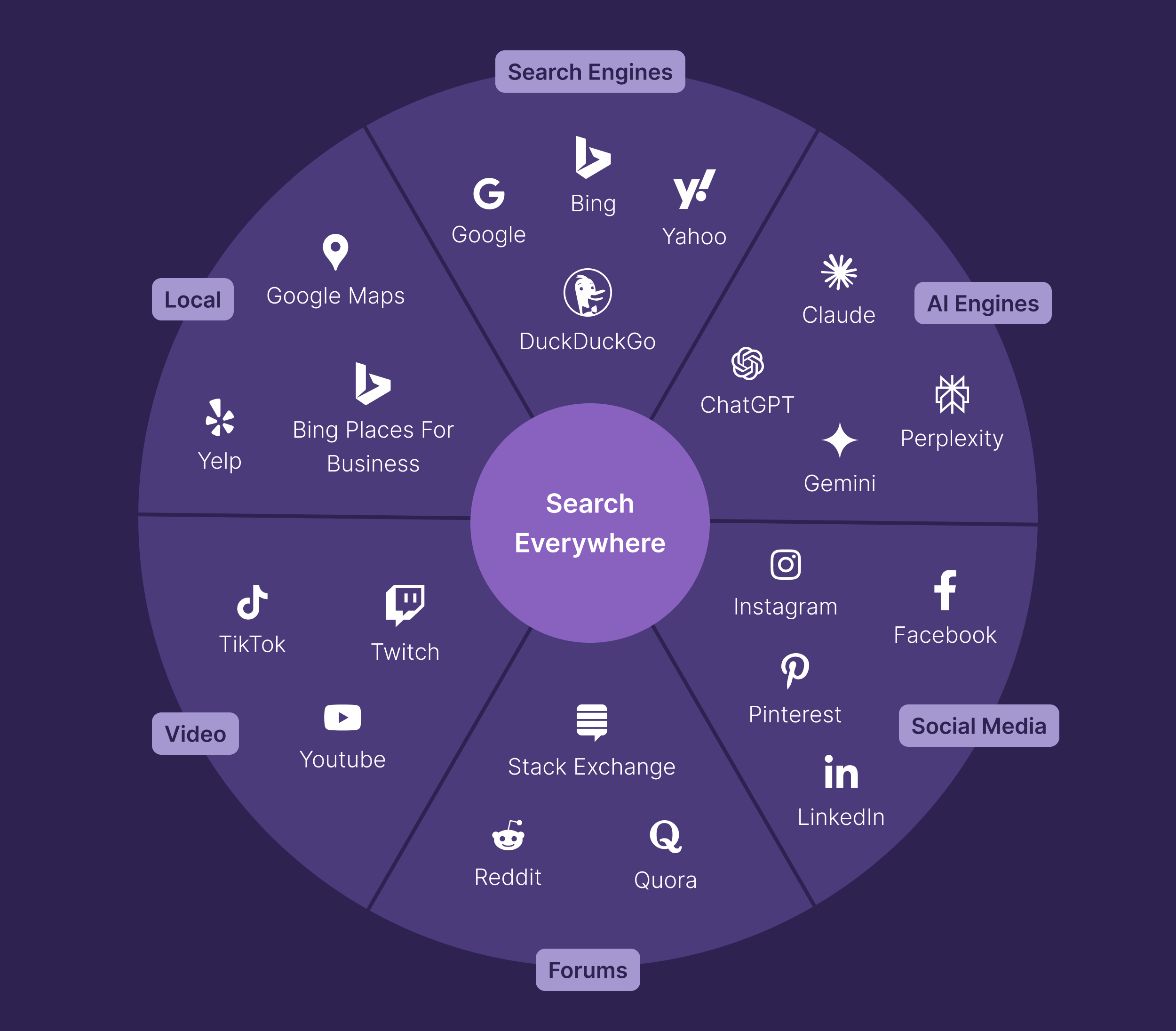
And among them, AI platforms are one of the fastest-growing discovery channels of all.
Research from Semrush predicts that LLM traffic will overtake traditional Google search by the end of 2027.

Our own data suggests that’s likely to be true.
In just three months, we saw an 800% year-over-year increase in referrals from LLMs.

We’re seeing tens of millions of additional impressions in Google Search Console as AI Overviews reshape how Google displays answers.
The brands that adapt now will be in a much stronger position to stay visible as this shift continues.
In this guide, I’ll explain:
- What GEO is and how it’s different from SEO
- Why you shouldn’t throw away everything you’ve already learned
- The top techniques that will help you optimize your content for generative engines (and drive results for your business in the process)

Free resource: Download our GEO Audit Checklist to work through every step I discuss in this guide.
What Is Generative Answer Optimization (GEO)?
Generative engine optimization is the practice of ensuring AI systems can find, understand, and reference your brand and content in their answers across platforms.
It’s a holistic approach that includes:
- Publishing content in the right places where AI platforms are most likely to discover it
- Earning positive brand mentions across the web, even without direct links
- Ensuring technical accessibility so AI crawlers can easily access and understand your content
Unlike traditional search, AI platforms go beyond returning a list of links. They pull relevant passages from across the web and use them to compose an answer. Your brand can show up in that answer as a mention, a citation, or both.
You’re no longer just optimizing to rank. You’re optimizing to become part of what AI platforms say when your audience asks questions.
For example, when I searched “best teleprompter 2026” in ChatGPT, BIGVU appeared directly in the answer, and its site was cited as a source.
That’s the kind of visibility GEO aims to create.

Why GEO Matters Now
Traditional Google search still dominates.
It’ll likely continue to drive most of your traffic in the near term.
But the way people discover information is changing fast.
Success used to mean ranking at the top of the SERP. Looking forward, there may not even be a “top spot.”
Instead, you need to become the solution AI platforms include (and recommend) in their answers.
The data tells the story:
ChatGPT reached 100 million users faster than any app in history (at the time). As of April 2026, it now has more than 900 million weekly users.
| Month | Weekly Users |
|---|---|
| November 2022 | 1 million |
| January 2023 | 30 million |
| November 2023 | 100 million |
| December 2024 | 300 million |
| February 2025 | 400 million |
| March 2025 | 500 million |
| October 2025 | 800 million |
| February 2026 | 900 million |
Google’s AI Overviews now appear on billions of searches every month.
Semrush data from 2025 found they show for roughly 16% of all queries, up from just 6.49% at the start of the year.

Nearly a third of US consumers used chat-based AI tools for shopping-related tasks by late 2025. Among those under 45, that number jumps to 41%.

These numbers point to one thing: generative engines are influencing YOUR audience too. So it makes sense to start optimizing for them now.
How GEO and SEO Work Together
You might look at this guide and think, “Isn’t this just SEO with a different name?”
And honestly?
In many ways, it is. But there’s a reason everyone’s talking about it.
Terms like GEO, AEO (answer engine optimization), and AIO (AI optimization) have exploded in interest because they reflect a real shift.

And with all the acronyms flying around, it can be tough to know who to listen to.

Further reading: SEO vs. GEO, AEO, LLMO: What Marketers Need to Know
I’m not saying GEO replaces SEO.
But it does help reframe how you think about discovery, which now happens across AI platforms and other surfaces beyond traditional search.
Put simply, the job of SEO now looks like this:
| Evolving From | Evolving To |
|---|---|
| SEO = Google Search | SEO = multi-surface visibility (Search, AI/LLMs, social) |
| Success = ranking for keywords | Success = being found across Search + Chat |
| SEO is a siloed function | SEO is cross-functional + connected to product, brand, PR, and social |
| Keyword-first content planning | Intent and entity-driven topic planning with semantic structure |
| Backlinks to pass PageRank | Traditional backlinks plus more focus on brand mentions and co-citations |
| Traffic as a core KPI | Visibility, influence, and conversions across touchpoints as core KPIs |
| Technical SEO as the foundation | Technical SEO as the foundation (with additional focus on JavaScript compatibility) |
The good news is that if you’ve invested in good SEO, you’re already a lot of the way there.
GEO builds on the foundation of great SEO:
- Creating high-quality content for your specific audience
- Making it easy for search engines to access and understand
- Earning credible mentions across the web
These same elements help AI engines decide which brands to reference.
But here’s the difference:
AI systems don’t surface information the same way Google does.
So some of your tactics and what you track need to evolve.
Let’s walk through how to do that.
7-Step Generative Engine Optimization Action Plan
We’re still in the early days of understanding exactly how AI engines pull and prioritize content.
But one thing is clear:
You need to adapt or reprioritize some traditional SEO tactics for generative engine optimization.
The first three steps below cover overarching best practices for GEO.
Steps 4-7 cover optimizing content for generative engines specifically (and how to track your results).
Step 1. Nail the Basics of SEO
As I said earlier, good GEO is generally good SEO. But not everything in your broader SEO strategy matters equally for generative engines.
I won’t go through every SEO fundamental here. We cover that in our guide to SEO basics.
Let’s focus on what matters most.
Make Your Site Easy to Read (for Bots)
Before AI platforms can reference your content, they need to be able to access and interpret it.
So make sure your website is:
- Crawlable and indexable: If AI platforms can’t access your pages, they can’t reference them in answers
- Fast and mobile-friendly: Slow, clunky sites hurt UX — and your chances of getting cited
- Secure (HTTPS): This is now table stakes, and it builds trust with users and AI systems
- Server-side rendering: Some AI crawlers still struggle with JavaScript-heavy pages, so server-side rendering is often the safer option
Show You’re Worth Trusting
AI systems are more likely to reference sources that appear credible, identifiable, and well-supported.
You can look at this through the E-E-A-T lens:
- Experience: Share real results, personal use, or firsthand knowledge
- Expertise: Stick to topics you truly know — and go deep
- Authority: Get quoted, guest post, or contribute to well-known sites
- Trust: Use real author bios, cite sources, and include reviews or testimonials

Note: I’m not suggesting these AI platforms use an explicit E-E-A-T system. But signals like these still help establish credibility, which makes content easier to trust and reference.
Step 2. Build Mentions and Co-Citations
AI systems don’t just look at backlinks to understand your authority. They pay attention to every mention of your brand across the web, even when those mentions don’t include a clickable link.

That’s because AI systems are built to understand entities, not just content.
They try to determine who’s behind the information and whether that entity shows up consistently across the web with clear connections to relevant people, brands, and topics.
So your brand needs to exist as a clearly defined entity, with consistent signals across your website, social profiles, and third-party mentions. The more coherent that picture is, the easier it is for AI systems to trust and reference you.
Backlinks are still important. But this changes how you should think about building your wider online presence.
Audit Your Current Mentions
Start by auditing where you’re currently mentioned. Search for your brand name, product names, and key team members across Google, social media, and industry forums.
Take note of what people are saying and where those conversations are happening.
You’ll probably find mentions you didn’t know existed. Some will be positive, others neutral, and a few might need your attention.
Also run your brand name and related terms through the AI platforms themselves.
- Does Google’s AI Mode cite your brand as a source for relevant terms?
- Does ChatGPT know who your team members are?
- What kind of sentiment do the answers have when you ask those platforms about your brand?

For a more in-depth sentiment analysis, use Semrush’s AI Visibility Toolkit.
It’ll let you track your LLM visibility (a by-product of good GEO) in top tools compared to your rivals:

The tool compares your brand to your rivals in terms of AI visibility, market share, and sentiment:

And it’ll show you where your brand strengths are and where you can improve:

Want to track your brand’s AI visibility? Get a free trial of Semrush One, which includes the AI Visibility Toolkit and Semrush Pro. See how you can compare to competitors across ChatGPT, Claude, and other AI platforms.
Keep Building Quality Backlinks
Just because mentions are more important than before with GEO, it doesn’t mean you should abandon traditional link building. Backlinks still matter for SEO, and they often lead to the kind of authoritative mentions that AI systems value.
But expand your focus beyond just getting links.
Further reading: How to Get High Quality Backlinks
Aim to Build Co-Citations and Co-Occurrences
There are a few different definitions out there of co-citation and co-occurrence.
I’ll be honest: the definitions don’t matter as much as the implications. I’ve seen one source define co-citations as the exact thing another source calls co-occurrence. So for this section, I’m just going to talk about what these are and why they matter, without getting bogged down in definitions.
The first important way to think of co-citations/co-occurrences is simply the mention of one thing alongside another.
In the case of GEO, we’re usually talking about your brand or website being mentioned alongside a different website or topic/concept on another website.
For example, if your brand is Monday.com, you’ll pick up co-citations involving:
- Your competitors (ClickUp, Asana etc.)
- Key terms or categories associated with your business (like “project management software”)
- Specific concepts or questions related to what you do (e.g., “kanban boards” and “how to automate workflows”)
In Monday’s case, there are hundreds of pages out there that mention it alongside ClickUp and Asana in the context of “project management tools”:

This suggests to Google and other generative AI tools that Monday and ClickUp are both related to the term “project management tools” and are both popular providers of this kind of software.
The other common way to think about co-citations is mentions of your brand across different, often unrelated websites.
For example, Monday being mentioned on Forbes and Zapier would be a co-citation involving them.

To sum it up:
- If two (or more) brands or websites are often mentioned alongside each other, AI systems are more likely to treat them as related (i.e., competitors)
- If a brand is often mentioned in the context of a particular topic, concept, or industry, AI systems are more likely to associate that brand with those things (i.e., what you offer)
- If lots of different websites mention a particular brand, AI systems are more likely to see that brand as worth referencing (i.e., probably trustworthy)
There’s a lot more to it, but this is a fairly basic overview of what’s going on.
How to Put This Into Action
To build citations, co-citations, and co-occurrences:
- Get mentioned alongside competitors: When publications write comparison articles or industry roundups, you want your name in that list. These co-citations help AI systems understand where you fit in your market.
- Participate in industry research and surveys: When analysts publish reports about your sector, being included gives you credibility (and any backlinks are a bonus).
- Show up in relevant online communities: Answer questions on Reddit, contribute to LinkedIn discussions, and join industry-specific forums. These interactions create mentions in places where AI systems often look for authentic, community-driven insights.

The goal is to become a recognized voice in your space.
The more often your brand appears in relevant contexts across the web, the more likely AI systems are to include you in their responses.
Step 3. Go Multi-Platform
Going beyond Google is something top SEOs have been telling us to do for a long time. But AI has made this an absolute must.
Platforms like Reddit, YouTube, and other user-generated content sites appear frequently in AI outputs.

In fact, according to Semrush data from January 2026, Reddit and LinkedIn are the two most cited domains across ChatGPT, Perplexity, and Google AI Mode.

So, a strong brand presence on these platforms could help you show up more often.
This helps in at least three ways:
- Reach your audience where they already are: Being active on multiple platforms lets you meet people where they already spend time. That helps you build engagement, strengthen brand awareness, and drive more conversions.
- Show up in more AI-referenced places: AI platforms don’t just pull from Google search results. They also draw from forums, social media, YouTube, and other sources beyond traditional SERPs.
- Reduce your dependence on one channel: A stronger presence across multiple platforms means you’re less exposed to one algorithm, one audience, or one source of traffic. Diversification is just good business practice.
Brian Dean did an excellent job of this when he was running Backlinko. That’s why you’ll see his videos appear in Google SERPs for ultra-competitive keywords like “how to do SEO”:

We’re taking our own advice here. In fact, it’s a big part of why we launched the Backlinko YouTube channel:

Here’s how to put this into practice:
- YouTube: People go there to learn how to do things, research products, and find solutions to problems. That makes product reviews, tool comparisons, and in-depth tutorials strong candidates for YouTube content.
- Podcasts: Podcast content and transcripts are beginning to surface in AI results, especially in Gemini. Building a presence here is a good opportunity to gain more AI visibility.
- TikTok and Instagram Reels: These platforms reach younger audiences who increasingly use them for search. Short-form videos that answer common questions in your industry can drive discovery, and AI platforms can sometimes cite them in responses.
- Reddit: AI platforms LOVE to cite Reddit for user-generated answers (especially Google’s AI Overviews and AI Mode). To grow your Reddit presence, find subreddits where your audience hangs out and share genuinely helpful advice when people ask questions related to your expertise. Don’t promote your business directly. Focus on being useful first.
- LinkedIn: For B2B topics, LinkedIn can work similarly to Reddit. Publish thoughtful posts and engage in relevant discussions to build your voice in professional circles. Those signals can then get picked up by AI systems looking for expert perspectives.
Step 4. Find Out What AI Platforms Are Citing for Your Niche
One of the fastest ways to understand what content to create is to study what AI platforms are already citing in your niche.
Start by directly testing whether/how your content appears in AI tools right now.
Go to ChatGPT, Claude, or Perplexity and ask questions that your content should answer.
In the example below, Backlinko is mentioned (great). But there’s also a YouTube video front and center. And forums are appearing too.
These are places we might want to consider creating content or engaging with conversations.

As you do this for your brand, pay attention to the sources they cite:
- Are they commonly mentioning your competitors?
- What platforms do they tend to cite? (Reddit, YouTube etc.)
- What’s the sentiment of mentions of both your brand and your competitors?
Then start testing variations of the same prompt.
For example, you could ask, “What’s the best email marketing software?”

Then try “Which email marketing tool should I use for my small business?”

Notice how the answers change and which sources keep showing up consistently.
In the example above, the first prompt mentioned MailerLite, which was absent in the list for small businesses.
But the second prompt pushed Mailchimp to the top and mentioned three new options (Constant Contact, Brevo, and ActiveCampaign).
If you were MailerLite and trying to reach small businesses, you’d want to understand why you’re not being cited for that particular prompt.

Pro tip: Test the same prompts across different AI platforms too. They each have their own citation patterns, so it’s a good idea to compare a few of them.
You can automate this process with tools like Profound or Peec AI. These platforms run prompts at scale, helping you understand how and where your brand appears. But they can be expensive.
That’s why I recommend you spend some time running these prompts manually at first.
By the way:
This isn’t just important for “big brands” or those selling products. You can (and should) do this if you run a blog, local business website, or even a personal portfolio.
For example, consultants and freelancers will find these tools often cite marketplaces like Upwork and Dribbble. If you don’t have a profile on there, you’ll likely struggle to get much AI visibility.

And if you’re a local business owner, you’ll often find specific service and location pages appear in AI responses:

This is useful for understanding the types of content you should be focusing on for GEO. Now it’s time to decide what topics to focus on in your content.
Step 5. Answer Your Audience’s Questions
The way people search with AI platforms is often more conversational than traditional Google search. That changes how you should plan your content.
Traditional SEO taught you to target specific keywords. You’d create a page optimized for “healthy meal prep ideas” and try to rank for that phrase.
But what happens when people are instead searching for “what to cook for dinner when I’m trying to lose weight”?
The answer might involve healthy meal prep as a solution. But it’s a completely different prompt (not a search) that gets to that answer (not a SERP).
When you run these queries through Google’s AI Mode, you see two totally different sets of sources and content types.
For the “healthy meal prep ideas” query (which is a perfectly valid and searchable term), the focus is listicles, single recipes, and YouTube videos. And the format is categories (bowls, wraps, and sandwiches etc.) with specific recipes:

But for “what to cook for dinner when I’m trying to lose weight,” the sources are primarily lists, forum results, or articles specifically around weight loss.
In this case, the format of the answer is largely broad tips for cooking healthily and then some general cooking styles or meal types, rather than specific recipes:

As more people get comfortable searching in conversational language, longer and more specific queries will become more common.
This makes this kind of intent analysis critical.
These longer, more specific queries represent huge opportunities.
Most companies aren’t creating content that answers these detailed questions.
The more specific the question, the more likely you are to show up when AI systems look for credible answers.
You want to own the long-tail queries that relate directly to your product or expertise.
But:
You can’t reasonably expect to create content for every single long-tail query out there. So how do you approach this in an efficient way?
How to Choose the Questions to Answer
Start by listening to the actual questions your customers ask.
Check your customer support tickets, sales calls, and user feedback. These real questions from real people often make the best content topics — because they’re the same kinds of questions people will ask these AI tools.
Don’t have any customers? No problem.
Use community platforms to find these conversational queries. Reddit, Quora, and industry forums are goldmines for discovering how people actually talk about problems in your space.

You can also use Semrush’s Prompt Research tool.
Enter a topic (e.g. “healthy meal prep”) and it will show you the exact prompts people are typing into AI platforms.
Look especially for question-based prompts.

Step 6. Structure Your Content for Generative Engines
AI systems process information differently than humans do. They break content into chunks and analyze how those pieces relate to each other.
According to Microsoft’s official AEO/GEO playbookMicrosoft’s official AEO/GEO playbook, most brands already possess the raw materials: product specs, reviews, FAQs, policies, pricing details.
But these assets need to be surfaced and structured for AI systems to see and act on them. An AI that can’t parse your content cleanly will simply move on to another website with better structure.
That’s why content structure is one of the highest-level GEO moves you can make. And it doesn’t even require creating anything new.
Note: A lot of what I say below is just good writing practice. So while this stuff isn’t necessarily “revolutionary,” these techniques are going to become more important as you focus on GEO.
One Idea per Paragraph
Keep your paragraphs short and focused on one main idea.
When you stuff multiple concepts into a single paragraph, you make it harder for AI systems to extract the specific information they need.
Also avoid burying important information in the middle of long sentences or paragraphs. Front-load your key points so they’re easy to find and extract.
And guess what?
It also makes it easier for your human readers to understand too. So it’s a win-win.
Use Clear Headings
Use clear headings and subheadings to organize your content logically.
Whatever your heading says, the content under it should deliver on that immediately.
Don’t drift. AI systems use headings to understand what each section covers. If the content doesn’t match, that section is harder to extract and cite.
For example, look at the headings in this section. Then read the first sentence under each one.
Notice how they’re all clearly linked?
This is a common technique when trying to rank for featured snippets. You’d have an H2 with some content that immediately answers the question…

…and this would rank for the featured snippet for that query:

This is still a valid strategy for traditional search. But for GEO, you need to have this mindset throughout your content.
I’d also recommend against making every H2 a question. That will quickly start to look over-optimized.
Just make sure the content under each heading clearly and logically delivers on what the heading says.
Break Up Complex Topics into Digestible Sections
If you’re explaining a complex or multi-step process, use numbered steps and clear transitions between each part.
This makes it easier for AI systems to pull out individual steps when someone asks for specific instructions. And it also makes the process easier for readers to follow.
Also write clear, concise summaries for complex topics. AI systems often look for these kinds of digestible explanations when they need to quickly convey information to users.

Use Quotes, Statistics, and Clear Statements
Include quotes, statistics, and clear statements that AI systems can easily extract.
Because pages with quotes or statistics have been shown to have 30-40% higher visibility in AI answers.

So instead of saying “Email marketing could be an effective channel for your business,” write “Email marketing generates an average ROI of $42 for every dollar spent.”
Note: Don’t just flood your content with quotes and stats. Only include them when they add value and genuinely help your readers.
Use Schema Markup
Schema markup can help AI systems understand who you are, what your content is about, and how to interpret it correctly.

But just remember: it’s not a magic potion for AI visibility.
Google’s official AI search guide states that structured data isn’t required for generative AI search, and there’s no special schema type that unlocks AI Overview inclusion.
The independent data backs that up.
A large-scale Ahrefs study found that pages with schema are cited more often by AI tools — but adding schema to already-cited pages didn’t make any significant difference.
The correlation reflects overall site quality, not schema’s direct effect.
Use schema because it’s solid SEO practice — not because you expect it to unlock AI citations. Well-built sites get cited.
Here are a few schema types worth prioritizing:
- Organization schema: Helps establish who is behind the site and gives AI systems clearer identity signals about your brand
- HowTo schema: Helps define the sequence of actions in a step-by-step process more clearly
- FAQ schema: Adds structure to Q&A content that AI platforms may find easier to interpret and extract
- Date schema: Helps AI systems assess when content was published (“datePublished”) and last updated (“dateModified”)
After implementing the schema, validate it at validator.schema.org to make sure it’s working correctly.

You don’t need to be a developer to do this.
Most CMS platforms, including WordPress, have plugins that can generate the markup for you automatically.
Make It Scannable
Use formatting like bold text to highlight important facts or conclusions and make your content easier to skim.
This helps readers quickly find key points. And it can also make important information easier for AI systems to identify.
Scannability has always been a big focus at Backlinko.
We use lots of images to convey our most important points and add clarity through visualizations:

We use clear headings to make our articles easy to follow:

And if you look at this article as a whole, you’ll see the same principle in action.
Clear headings, short paragraphs, bullets, bolded lead-ins, and visual breaks make the content easier to scan and follow.
The goal is to make your content easy to read and navigate for humans and machines. Well-structured content typically performs better across all types of search and discovery.
Step 7. Track Your Visibility in LLMs
AI visibility isn’t a metric you check once.
Which brands get mentioned, which sources get cited, and how your brand is described can all shift significantly over time.
That means monitoring needs to be ongoing.
Tracking your visibility in AI-generated responses helps you understand what’s working and where you need to focus your efforts.
But where do you start? And what should you track?
Manual Testing as a Starting Point
Start with manual testing. This is the simplest way to see how you’re performing right now.
Ask the same questions across different AI platforms, like ChatGPT, Claude, Perplexity, and Google (both AI Mode and AI Overviews). Take screenshots of the responses and note which sources get cited.
Do this regularly, and you’ll start to see patterns in which types of content get mentioned and how your visibility changes over time.
Honestly though: you’re going to struggle to get a lot of meaningful data doing this manually. It’s not scalable. And so much of what an AI platform outputs depends on prior context, including:
- Past conversations
- Previous prompts within the same conversation
- Project or chat settings
A study by SparkToro proved this inconsistency. They ran 12 prompts across ChatGPT, Claude, and Google AI Mode nearly 3,000 times.
The study found that AI tools produce the same brand recommendation lists less than 1 in 100 times, and identical ordering less than 1 in 1000 times.
That means the right question isn’t “where do I rank in ChatGPT?” because there is no clear rank.
The right question is: “How often does my brand appear across a meaningful sample of prompts?”
Which is exactly what makes it hard to gather truly reliable data on your own.
Manual tracking is really more of a “feel” test that is best treated as a rough directional check, not a complete tracking system.
Use AI Tracking Tools
You can start with a free AI visibility checker for quick, top-level insights and see where your brand currently stands.
But for more comprehensive tracking, dedicated tools can automate the process.
Tools like Semrush Enterprise AIO help you track your brand’s visibility across multiple AI platforms like ChatGPT, Claude, and Google’s AI Overviews.

It shows you exactly where you stand against competitors and gives you actionable steps to improve.
Another option is Ziptie.dev. It’s not the most polished tool yet, but they’re doing some really interesting work — especially around surfacing unlinked mentions across AI outputs.

The key here: don’t treat AI tracking like keyword rank tracking. You don’t need to monitor thousands of prompts to see where you show up.
Instead, pick 10-20 representative prompts that reflect how your audience searches. Run them regularly across platforms in your AI tool fo choice, and track your mention rate over time.
That directional signal is far more meaningful than any “AI ranking” your tools might report.
Why Talk to Your Boss (or Clients) About GEO?
You’ve seen the steps. Now you need a story.
GEO gives you a simple way to explain what’s changing in search without making it sound like everything you knew about SEO suddenly stopped working.
It helps you say:
- Traditional SEO still matters
- Past investments in content and authority still count
- But visibility now means more than rankings alone
- Your brand also needs to be cited, mentioned, and trusted in AI-generated answers
That makes it easier to get buy-in, justify your strategy, and keep moving forward without having to rebuild your entire approach from scratch.
You Need to Start Now to Stay Visible
This space is evolving fast. New capabilities are rolling out monthly.
But the brands showing up consistently in AI search aren’t chasing every new development. They’re building something durable: content, presence, and trust signals that AI systems are designed to find and reference.
Start with the basics by continuing to optimize for strong rankings and authority.
Then grow your presence by adding the GEO layer on top of your SEO efforts.
And keep tracking your AI visibility as you go.
Download our free GEO Audit Checklist. It covers all seven steps I discussed in one place so you can work through them systematically.
Also, check out our video with Backlinko’s founder, Brian Dean. We dive into how search habits are changing and how you can build a resilient, multi-channel brand.
Backlinko is owned by Semrush. We’re still obsessed with bringing you world-class SEO insights, backed by hands-on experience. Unless otherwise noted, this content was written by either an employee or paid contractor of Semrush Inc.